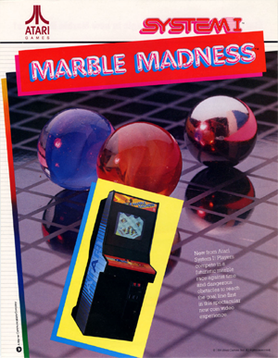
Marble Madness, designed by Mark Cerny at Atari Games in 1984, was the first arcade game with a trackball and one of the first with an original musical score. Its physics-driven marble racing was hypnotic — and the NES port kept the challenge intact.
History & Development
Cerny built Marble Madness in a year on early 3D polygon hardware, inspired by marble race toys and the idea of a game that lasted only a few minutes per play. Its isometric courses and sliding physics were revolutionary. The NES conversion preserved the six treacherous courses.
Gameplay
Players guide a marble over winding courses — grass, marble, black — racing the clock while physics conspire against every turn. Enemies like marble eaters and acid pools punish mistakes, and the final course turns the screen into a chaotic obstacle storm. Multiplayer racing doubles the tension.
Legacy & Reception
Marble Madness pioneered physics-based gameplay and influenced Super Monkey Ball and Marble Blast. Its short-session design was decades ahead of its time, and the NES version remains one of the console's best technical adaptations of an arcade classic.